This week focused on planning the final project as a complete integrated system. The goal was to define what the project will do, what parts I will design and fabricate, what components I will use, what questions still need to be answered, and how the final result will be evaluated.
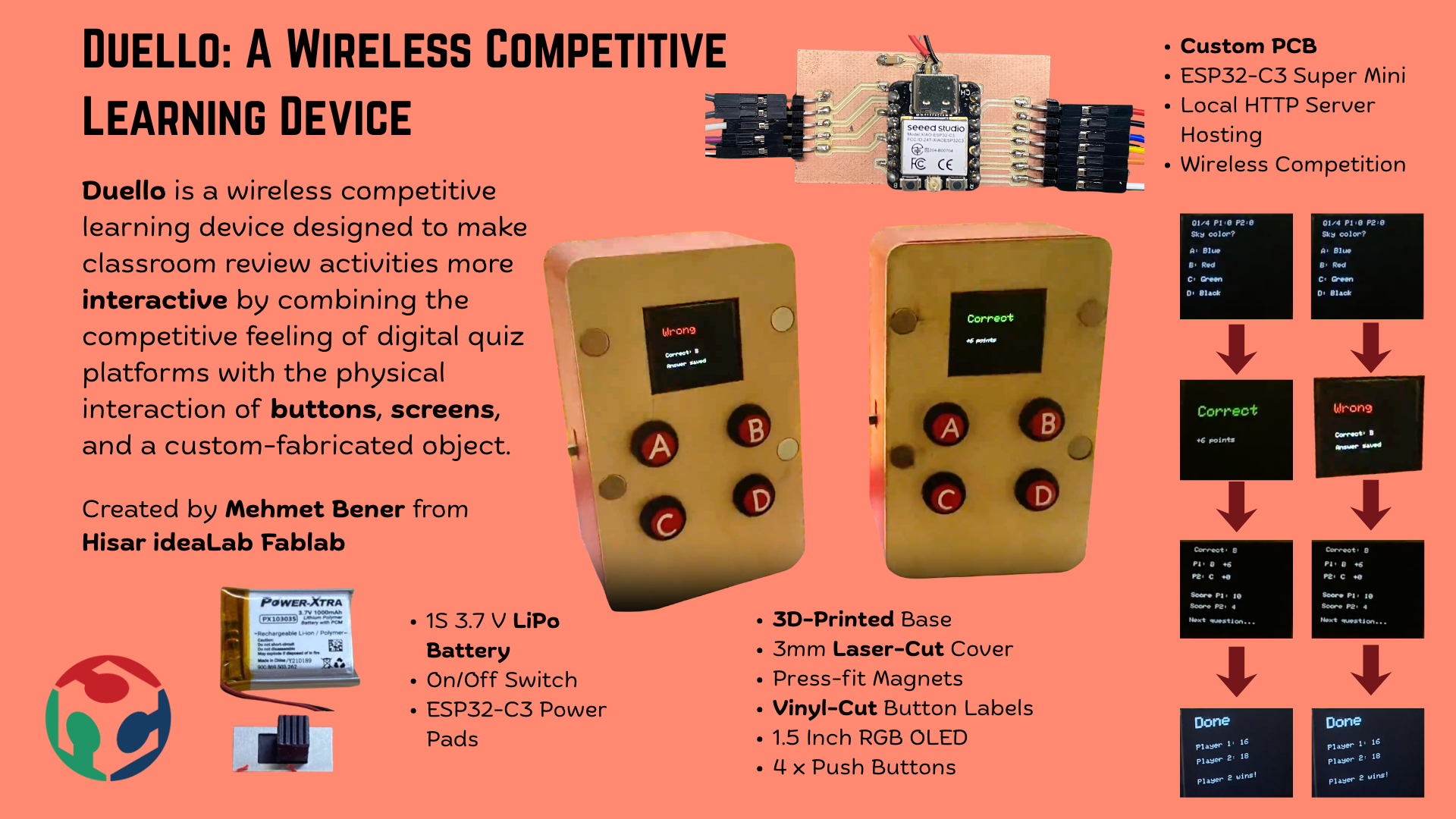
My final project is called Duello. It is a wireless competitive learning device for middle school students. The project combines digital fabrication, custom electronics, embedded programming, wireless networking, and system integration into one portable classroom quiz device.
Duello fits mostly into the areas of consumer electronics, education, networks, electronics, toys, communities, and labs. It is a learning device, but it also works like a small game console because students interact with it through physical buttons and a screen.
What will it do?
Duello will let two students play a wireless competitive quiz game using two physical devices.
Each device has:
four physical answer buttons labeled A, B, C, and D a 1.5 inch RGB OLED screen an ESP32-C3 based custom PCB a 1S 3.7 V 1000 mAh LiPo battery an on/off slide switch a 3D-printed base a laser-cut plywood cover
The teacher or developer can set the quiz questions inside the program code. The current demo is designed around a 10-question game, but the number of questions can be changed in the code. Each question currently has a 10 second time limit, which can also be changed.
One ESP32-C3 device creates a local Wi-Fi server. The second ESP32-C3 device connects to it wirelessly. Both players see the same question, answer using the physical buttons, and receive points based on correctness and answer speed.
The scoring system gives up to 10 points for a correct answer. The score decreases by 1 point for each second that passes. Incorrect answers, missing answers, or answers after the time limit receive 0 points. At the end of the quiz, the OLED shows the final scores and the winner.
Who’s done what beforehand?
Duello is inspired by existing classroom quiz platforms, quiz buzzers, and handheld game devices.
Kahoot already uses competitive classroom questions and speed-based scoring, but it normally requires phones, tablets, or computers. Traditional quiz buzzers use physical buttons, but they usually do not include a full screen-based quiz interface or wireless game state synchronization. Handheld game consoles and arcade controllers also inspired the project because they use physical buttons and immediate visual feedback.
Duello combines these ideas into a custom fabricated object. The original part of the project is not only the quiz idea, but the complete integration of the physical enclosure, custom PCB, OLED interface, battery system, buttons, wiring, and ESP32-to-ESP32 wireless game logic.
What sources will you use?
I will use the following sources and references:
- ESP32-C3 Super Mini pinout references
- ESP32 Arduino Wi-Fi documentation
- Arduino
WiFi.hlibrary examples - Arduino
WebServer.hlibrary examples - Arduino
HTTPClient.hlibrary examples - Adafruit GFX library documentation
- Adafruit SSD1351 OLED library documentation
- KiCad documentation
- Roland SRM-20 PCB milling workflow
- Bambu Studio slicing workflow
- xTool P3 laser cutting workflow
- Cricut Maker 3 vinyl cutting workflow
- My previous Fab Academy documentation from Electronics Design, Electronics Production, Input Devices, Output Devices, Networking and Communications, 3D Printing, Laser Cutting, and Vinyl Cutting
I will also use my own design files, code files, PCB files, and test results from the final project development process.
What will you design?
I will design the full Duello system.
The main parts I will design are:
- the 3D-printed base
- the laser-cut plywood cover
- the OLED screen stand
- the magnet-based cover attachment
- the button layout
- the white vinyl A/B/C/D labels
- the custom ESP32-C3 PCB
- the internal wiring system
- the embedded quiz code
- the Wi-Fi host/client communication system
- the scoring and game logic
- the final project slide and system diagram
The final device is approximately 85 mm wide, 140 mm long, and 60 mm high. The base is 3D printed using premium red PLA. The cover is made from 3 mm plywood. The buttons are red, and the button labels are white vinyl stickers.
The 3D model is designed in Fusion 360. The cover geometry is exported from Fusion 360 and edited in Illustrator before laser cutting.
What materials and components will be used?
The main materials and components are:
| Part / Material | Description |
|---|---|
| ESP32-C3 Super Mini | Main microcontroller and Wi-Fi module |
| Custom PCB | Integrates the ESP32-C3, button inputs, OLED connections, and power connections |
| 1.5 inch RGB OLED | SPI OLED screen using SSD1351 driver |
| 4 push buttons | Physical A/B/C/D answer buttons |
| 1S 3.7 V 1000 mAh LiPo battery | Portable power source |
| Slide switch | Turns the device on and off |
| 100 µF 25 V capacitor | Connected near the battery input and GND |
| 3 mm plywood | Laser-cut cover |
| Premium red PLA | 3D-printed base |
| White vinyl | A/B/C/D button labels |
| Magnets | Connect the base and cover |
| 2.80 mm insulated female Faston connectors | Button wiring |
| 7-pin PH connector / crimped cables | OLED wiring |
| Jumper wires | Internal connections |
| Double-sided 3M mounting tape | PCB mounting |
The OLED uses 3.3 V logic and power. The buttons share a common ground and use INPUT_PULLUP, so a pressed button reads as LOW.
Where will come from?
The components and materials will come from:
| Source | Parts |
|---|---|
| Direnc.net | electronic components, connectors, switch, capacitor, wiring parts |
| Robotistan | electronics and module components |
| Hisar Fab Lab inventory | plywood, PLA filament, vinyl, PCB material, soldering and fabrication supplies |
| Fab Academy GitLab | project repository and documentation hosting |
The final project files will be shared through my Fab Academy GitLab repository.
How much will they cost?
The approximate cost for one device is:
| Item | Approx. cost in TRY | Approx. cost in USD |
|---|---|---|
| ESP32-C3 Super Mini | 150 TRY | 5 USD |
| 1.5 inch RGB OLED module | 450 TRY | 14 USD |
| 4 push buttons | 200 TRY | 6 USD |
| 1S 3.7 V 1000 mAh LiPo battery | 250 TRY | 8 USD |
| Slide switch | 30 TRY | 1 USD |
| Capacitor and small electronic parts | 50 TRY | 2 USD |
| PCB material | 100 TRY | 3 USD |
| Wires, crimps, Faston connectors, PH connector | 150 TRY | 5 USD |
| Magnets | 100 TRY | 3 USD |
| PLA filament | 100 TRY | 3 USD |
| 3 mm plywood | 50 TRY | 2 USD |
| Vinyl sticker material | 25 TRY | 1 USD |
| Mounting tape / assembly materials | 50 TRY | 2 USD |
| Estimated total for one device | 1655 TRY | 55 USD |
For two devices, the approximate total cost is:
| Quantity | Approx. cost in TRY | Approx. cost in USD |
|---|---|---|
| 2 devices | 3310 TRY | 110 USD |
These are approximate costs because some materials came from Fab Lab inventory and some prices can change depending on supplier availability.
What parts and systems will be made?
The project will include the following parts and systems:
Physical parts
- 3D-printed base
- 3D-printed OLED stand integrated into the base
- laser-cut plywood cover
- vinyl-cut A/B/C/D labels
- magnet attachment system
- internal mounting layout
Electronics
- custom ESP32-C3 PCB
- OLED connection system
- button input system
- battery power system
- slide switch power control
- capacitor near battery input
- crimped button and OLED wiring
Software
- host device code
- player/client device code
- Wi-Fi Access Point setup
- HTTP server routes
- quiz state handling
- answer submission
- scoring system
- OLED display screens
- button input handling
Integrated system
- two-device wireless quiz game
- synchronized question flow
- speed-based scoring
- final winner display
- battery-powered portable enclosure
What processes will be used?
The project will use the following processes:
| Process | Tool / Machine / Software |
|---|---|
| 3D CAD design | Fusion 360 |
| Vector editing | Adobe Illustrator |
| 3D printing | Bambu Lab A1 |
| Slicing | Bambu Studio |
| Laser cutting | xTool P3 |
| Vinyl cutting | Cricut Maker 3 |
| PCB design | KiCad |
| PCB milling | Roland SRM-20 |
| Soldering | Fab Lab soldering tools |
| Crimping | Faston and connector crimping |
| Embedded programming | Arduino IDE |
| Wireless networking | ESP32-C3 Wi-Fi |
| System testing | full game, battery, Wi-Fi, drop, and shake tests |
The 3D-printed base takes approximately 3–4 hours to print. The laser-cut cover takes approximately 20 seconds to cut.
What questions need to be answered?
The main questions I need to answer are:
- Can two ESP32-C3 devices communicate reliably over Wi-Fi?
- Can one ESP32-C3 host the game state while the other connects as a client?
- Can both devices show the same question flow clearly?
- Can the OLED display enough information for the quiz interface?
- Can the buttons be mounted securely on the laser-cut cover?
- Can the shared-ground button wiring work reliably?
- Can the LiPo battery power the full system?
- Can the ESP32-C3 board handle power regulation and charging through USB?
- Can the internal cables stay connected during movement?
- Can the magnet-based cover connection survive handling?
- Can the device survive a drop test and shake test?
- Can the timing between the two devices be accurate enough for a playable quiz game?
- Can middle school students understand and use the interface without extra explanation?
Some remaining improvement questions are related to exact timing synchronization over Wi-Fi and user experience fine-tuning.
How will it be evaluated?
The project will be evaluated based on whether it works as a complete integrated system.
Success means:
- two devices can turn on using their LiPo batteries
- one device creates the local Wi-Fi game server
- the second device connects to the host device
- both devices display the quiz questions
- both players can answer using physical buttons
- the system records answers correctly
- the system calculates scores using correctness and answer speed
- both devices show round results
- both devices show the final winner
- the enclosure holds all electronics safely
- the OLED, buttons, PCB, battery, and wiring stay connected
- the device survives normal classroom handling
I have already tested:
- OLED output
- button input
- Wi-Fi connection
- two-device communication
- battery power
- full game flow
- shake test
- drop test from approximately 100 cm
After the shake test, the electronics continued to work. After the drop test, the device still functioned. This shows that the project is not only a collection of separate parts, but an integrated physical and electronic system.
The final evaluation scenario is two middle school students using the two devices to play a complete quiz round.
Final Project Summary Slide
For now the poster and video are placeholders.
Poster