Introduction
This week was about thinking about how my final project could be shared, protected, improved, and possibly developed after Fab Academy.
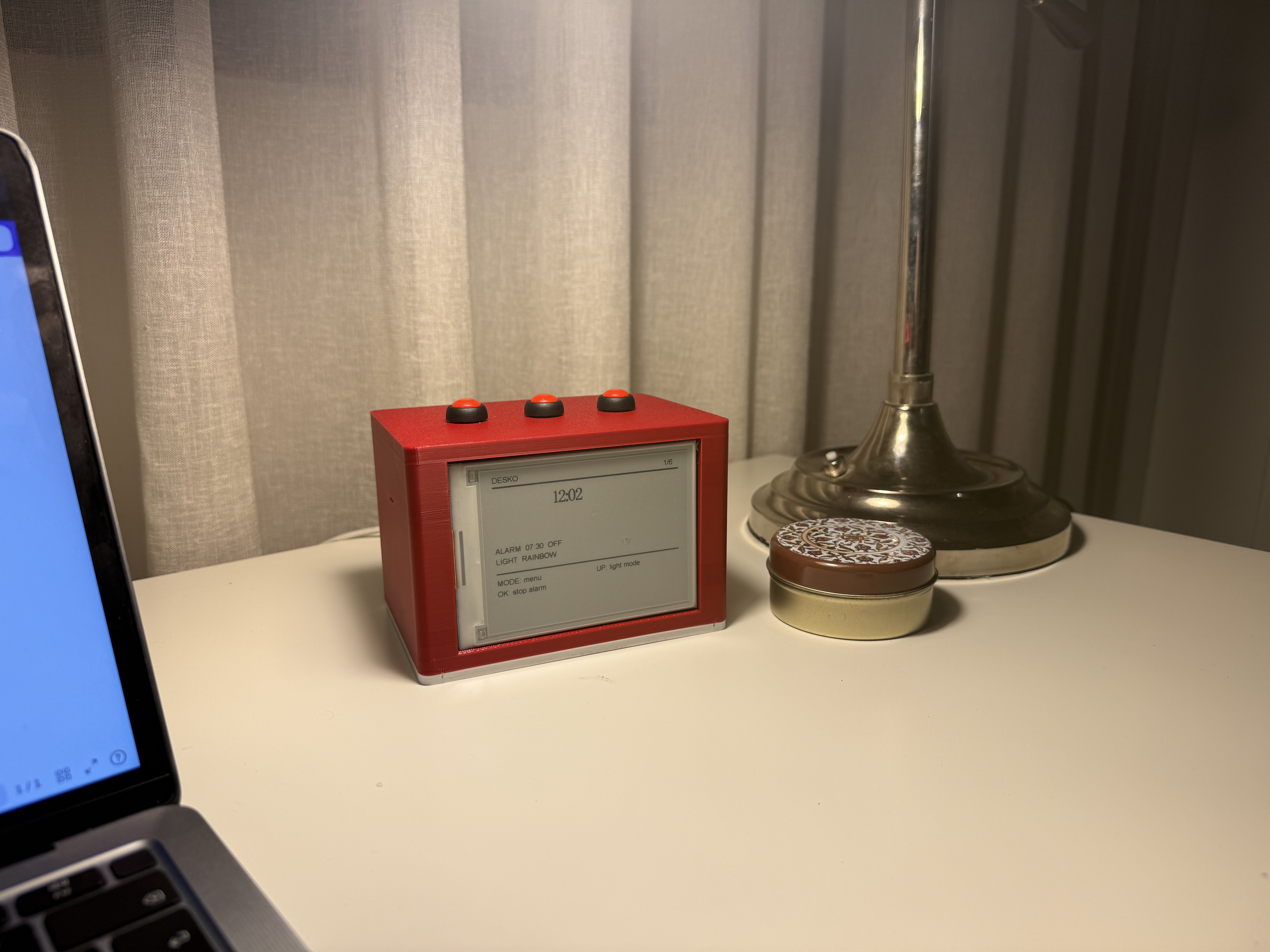
At this point, DESKO was already close to the final presentation stage. The main systems were defined, and I was mostly working on coding and integration. I was trying to make the e-paper display, NeoPixels, buttons, buzzer, alarm, countdown, stopwatch, and web interface work together in the same program.
I was also improving the clock UI to make it clearer and more user friendly before the final project presentation.
Created a dissemination plan for your final project
The main place where I will share DESKO is my Fab Academy documentation page. This page will include the development process, design files, code, photos, videos, and final project files.
DESKO can also be shared through:
- my GitLab repository
- final project video
- personal portfolio
The target audience is mainly students, makers, and people interested in clocks, desk setups, interactive devices, and physical computing.
The project is useful as a documented prototype because it combines many Fab Academy topics into one object: design, fabrication, electronics, programming, interface design, and system integration.
Outlined future possibilities and described how to make them probabilities
For now, DESKO makes more sense as an open-source educational prototype than a commercial product. It is still being tested and improved, so sharing the process is more realistic than selling it immediately.
A future version could become a small desk or bedside clock kit if the design becomes more reliable and easier to assemble.
To make this possible, I would need to improve:
- custom PCB instead of loose wiring
- cleaner internal layout
- more reliable power system
- better enclosure tolerances
- more polished e-paper UI
- more polished web interface
- real-time clock module for accurate timekeeping
- easier setup for normal users
If these parts become reliable, DESKO could be shared as a maker kit or a small customizable clock project.
Intellectual property and licensing
I want DESKO to stay open because it was developed as part of Fab Academy. Other students should be able to learn from it, reuse parts of it, and improve it.
Documentation and design files
For the documentation and design files, I would use:
Creative Commons Attribution-ShareAlike 4.0 International
CC BY-SA 4.0
This allows others to share and adapt my documentation or design files, but they need to give credit and share their version under similar conditions.
Code
For the code, I would use:
MIT License
This fits the software part because it allows others to use, edit, and improve the code while keeping the original license notice.
Business model
DESKO is currently a prototype, so the first business model is not direct product sales. The most realistic model is an open-source educational project.
Possible future directions:
| Direction | Description |
|---|---|
| Open-source project | Share code, files, and documentation for learning |
| Maker kit | Provide parts, enclosure files, and instructions |
| Workshop project | Use DESKO as a teaching project for embedded systems |
| Small product | Develop a more finished version with custom PCB and enclosure |
If developed as a kit, DESKO could be aimed at students.
What tasks have been completed, and what tasks remain?
| Task | Status |
|---|---|
| Main project concept | Completed |
| Main component selection | Completed |
| E-paper display test | Completed |
| NeoPixel lighting test | Completed |
| Button control | Completed |
| Buzzer feedback | Completed |
| Alarm logic | Mostly completed |
| Countdown logic | Mostly completed |
| Stopwatch logic | Mostly completed |
| Web interface | Working, needs visual polish |
| Full code integration | In progress |
| Final enclosure | In progress |
| Final wiring | Needs cleaning |
| Final photos | Not completed |
| Final video | Not completed |
| Final slide | Not completed |
At this stage, the main task is not adding many new features. The main task is making the existing system stable, clear, and presentable.
What is working? What is not?
Working
The main functions are now inside one code structure. The physical buttons can control the menu system, and the web interface can control important functions from a browser.
Not fully working yet
Some parts still need refinement:
- the e-paper UI needs to be clearer
- the web interface needs better visual design
- the alarm needs more testing
- the wake-up light needs comfort testing
- the final wiring needs to be cleaned
- the enclosure needs final fitting
- the system needs longer reliability testing
The project works technically, but it still needs polishing before the final presentation.
What questions need to be resolved?
Before the final presentation, I still need to resolve these questions:
- Is the menu clear enough for someone using DESKO for the first time?
- Is the web interface easier than using only the buttons?
- Should the alarm be controlled mainly from the buttons or from the browser?
- Is the wake-up light bright enough but still comfortable?
- Is the countdown LED feedback easy to understand?
- How often should the e-paper display refresh?
- Can the wiring fit safely inside the enclosure?
- Will the device work reliably during the final presentation?
- Is the final object strong enough for repeated use?
These questions are mainly about reliability and user experience.
What have you learned?
This week helped me think about DESKO as more than a technical prototype. I had to think about how the project should be shared, what license makes sense, who might use it, and what would be needed if it became a kit or product.
I also learned that near the end of a project, adding more features is not always the best decision. At this stage, improving reliability, clarity, and user experience is more important.